How to Learn American Mahjong Before You Buy a Set
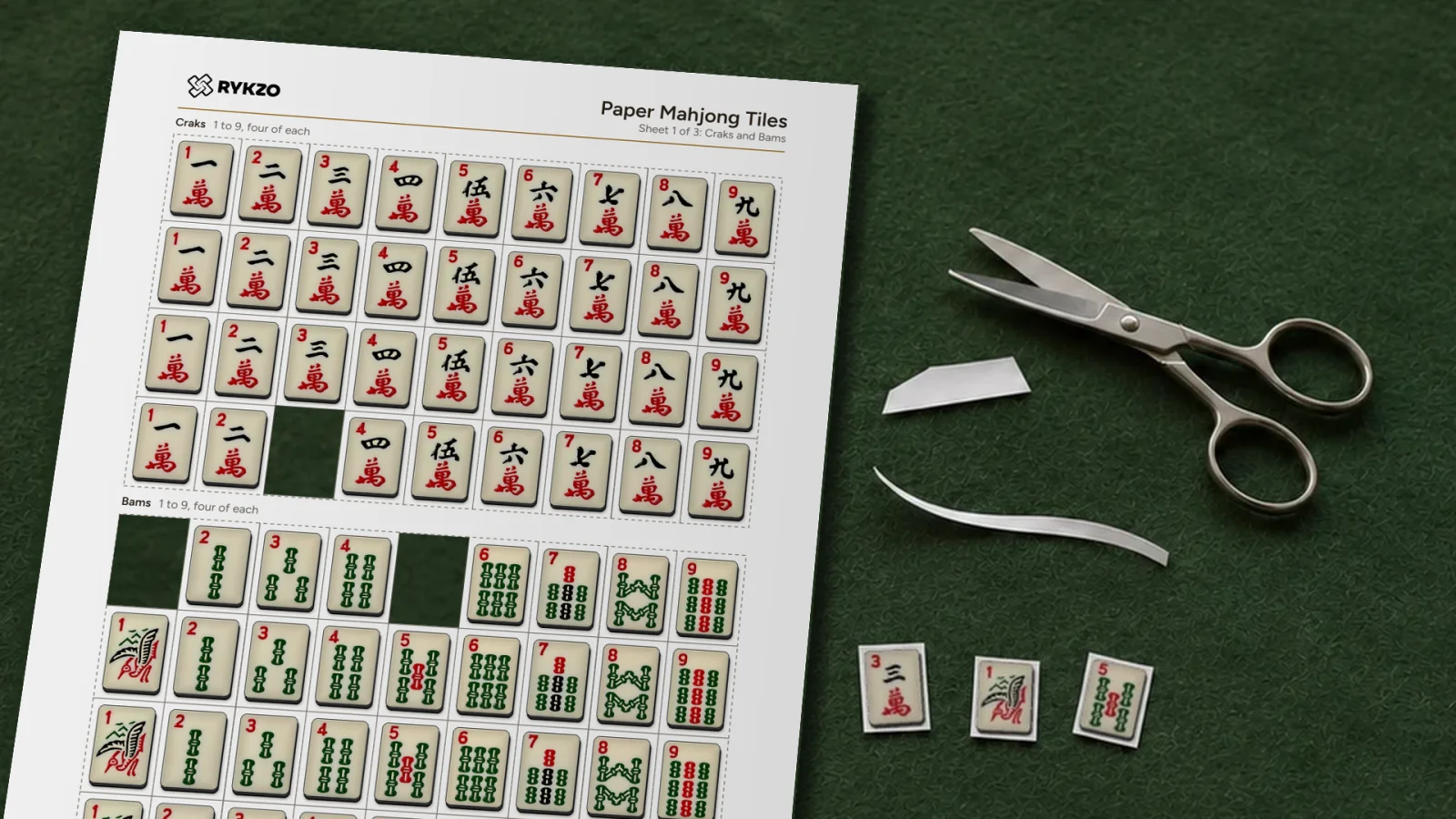
You do not need to own a set to start learning American mahjong. Paper tiles are enough. You can hold the tiles, sort them and lay out a hand. The card and the rules make more sense once you have done it.
This guide shows how to learn with a printed set: what to print, how to sort it and three ways to practice before you buy anything.
What you need to start
- Tiles. Paper ones work well for learning, and the next section shows how to make them.
- A card with this year's hands. The hands change every year, so you need the current card. The National Mah Jongg League publishes one every year, and there are other cards too.
- A table. Any flat table is big enough to lay out a hand.
Print and cut your paper tiles
Our free Paper Mahjong Tiles are three US Letter sheets with all 152 tiles. To print them:
- Print one copy of each sheet, in color, at 100% ("Actual size"). Do not choose "Fit to page," or the tiles will come out too small.
- For sturdier tiles, print on 65 lb cover cardstock.
- Cut along the dashed lines.
- Keep the tiles in an envelope between sessions.
The third sheet has a checklist, so you can tick off each group as you cut.
Sort them into groups
Before you play with the tiles, sort them. Make one pile for each kind and count it:
- 36 Craks, 36 Bams and 36 Dots, four of each number from 1 to 9.
- 16 Winds: North, East, West and South, four of each.
- 12 Dragons: Red, Green and White, four of each.
- 8 Flowers.
- 8 Jokers.
Together that makes 152. If your count comes out different, a tile is missing from a pile or sitting in the wrong one. Finding it is the first lesson in telling the tiles apart.
The bird is the 1 Bam, and the White Dragon is the one players call "Soap." American Mahjong Tiles Explained shows what each kind of tile looks like.
Build a hand from your card, face up
Open your card and choose one hand. Then look through your piles and lay its tiles in a row on the table. This shows you what a hand on the card is made of.
A few things to watch for as you build:
- Each Dragon goes with one suit. Red goes with Craks, Green with Bams and Soap with Dots.
- A 0 on the card means Soap. A Soap used as a zero goes with any suit.
- Any Flower fits an F. All eight Flowers count the same, whatever is printed on them.
- A Joker can take the place of any tile in a group of three or more identical tiles. It can never stand in for a tile in a pair or for a single tile. Put a Joker in place of one tile in a group of three to see how it works.
Build a few hands this way, with no clock and nobody waiting for you. Hands that looked like a wall of symbols on the card start to look like tiles you recognize.
Deal yourself a hand
Now try a practice deal. Turn all the tiles face down, mix them and take 13. In a real game the tiles come from the wall, and East starts with 14 tiles and everyone else with 13.
Turn your tiles over and sort them by suit. Then look through the card for the hands that match what you were dealt. You will find that a few of them are closer than the rest. Count how many tiles each one still needs, and choose the one that needs the fewest.
To see how players follow which tiles are gone, read How to Keep Track of the Tiles in American Mahjong.
Practice the Charleston with friends
One printed set is enough for a whole table, because you deal from the same pile. Mix the 152 tiles face down, and have each player take 13.
Then try the first Charleston, which is required in every game. Each player passes three tiles to the right, then three across, then three to the left. Choose your three tiles before you pick up the ones coming to you, and pass them face down. A Joker can never be passed.
You will make mistakes, and paper tiles are a kind place to make them. The Charleston in American Mahjong, Step by Step explains every pass, so keep it open on the table.
What paper tiles cannot do
Paper tiles are light and flat. They slide when you bump the table, they do not stand up in a rack, and they do not feel like a real set in your hand. Some tips:
- Lay your hand in a row on the table, with the tiles overlapping slightly, so you can read all of them.
- Keep the tiles you are not using in an envelope, so nothing goes missing.
- Mix the pile face down on the table, because paper tiles do not shuffle like real ones.
Paper tiles also cannot teach you the wall, which you build with real tiles and a rack. Learn that part when you have a set.
When you are ready for a set
Paper tiles are a fine way to learn. When you are ready for a set, look for one with all 152 tiles and four racks. Many store-bought sets add a few spare tiles. If your set has extra Flowers, Jokers or blank tiles, read the instructions that come with it before you play.
If you would like the rules in plain words next to your paper tiles, the Simple Guide is free.
Have a question about these rules? Write to us. We read every message, and your question may become a future post.
Sources
We explain the rules in our own words, and everything in this post was checked against the official sources of the National Mah Jongg League:
- Mah Jongg Made Easy (2024 edition): page 5 (the number of tiles, the groups and the Winds), pages 5 and 6 (the Dragons and the Soap), page 6 (the suit each Dragon goes with, the Flowers and the Soap as a zero), page 7 (the suits, the 1 Bam and the Jokers), page 8 (the Craks and practicing alone), pages 9 and 10 (the wall and the deal), pages 12 to 14 (the first Charleston, passing face down and that a Joker may never be passed).
The printing steps come from the Paper Mahjong Tiles themselves. The tips on practicing, on choosing a hand and on keeping paper tiles in order are advice, not rules.
Mahjong help by email every week
Our newest blog posts and one rules question players often ask, with the answer. When we have a new book or accessory, you’ll read about it there too.
Keep reading
 Learn the game
American Mahjong Tiles Explained
 Learn the game
How to Play American Mahjong: A Beginner's Guide