Learn to play American mahjong
How American mahjong is played, step by step, with the words you’ll hear at the table.
The basics, step by step
These are the standard rules, told in a few words. Many tables play house rules, so agree on them before you start. If you’re brand new, our beginner’s guide walks you through one game and explains how experienced players recommend learning.
- 1
The tiles
American mahjong is played with 152 tiles. There are three suits, Bams, Craks and Dots, numbered 1 to 9, with four of each tile.
There are also four Winds (North, East, West and South), four of each, and three Dragons, red, green and white, four of each. The white Dragon is called Soap. Last come 8 Flowers and 8 Jokers.
Read more: American Mahjong Tiles Explained
- 2
The card
Every year the National Mah Jongg League puts out a new card with the hands that count that year. You win by completing exactly one of them.
Every player needs this year’s card. We don’t reproduce its hands here, so keep yours next to you.
- 3
Reading the card
Each hand on the card is a line of 14 numbers and letters, one for each tile, in one, two or three colors. The colors tell you how many suits the hand uses. Winds, Flowers and 0s have no suit, so their color doesn’t count. You choose which suit goes with each color, so a green hand doesn’t have to be in Bams.
N, E, W and S are the Winds, F is a Flower and D is a Dragon. A D printed in the same color as some numbers is usually the Dragon of their suit. The red Dragon goes with Craks, the green Dragon with Bams and Soap with Dots. A 0 is always Soap, and it goes with any suit.
The note in parentheses after a hand says which numbers, suits, Winds or Dragons you may use. When the note and the colors disagree, follow the note.
At the end of each line is an X or a C. With X, you may call discards and lay groups face up on your rack. With C, the hand stays concealed until you win. The number next to the letter is what the hand is worth.
The Mahjong Line Reader shows one line of the card at a time.
- 4
Setting up
Four players sit around the table. Each one builds a wall in front of their rack: 19 stacks of two tiles.
The host usually starts as East. East rolls the dice and breaks the wall to deal. East ends up with 14 tiles and everyone else with 13. After each game, the player on East’s right becomes East.
- 5
The Charleston
Before play begins, everyone passes tiles they don’t need. The first Charleston is required: pass 3 tiles to the right, then 3 across, then 3 to the left. On that last pass you may make a blind pass, passing along 1 to 3 of the tiles coming to you without looking at them.
The second Charleston is optional. Any player can say no to it, or stop it before anyone looks at the tiles passed to them. It goes left, across, then right, and its last pass can be a blind pass too.
Last comes an optional courtesy pass with the player across from you, of 0 to 3 tiles. The player who wants to pass fewer tiles sets the number. Jokers are never passed.
Read more: The Charleston in American Mahjong, Step by Step
The Mahjong Tile Shuffler cards carry a short guide to the Charleston.
- 6
Taking turns
East discards first, and play moves to the right. On each turn after that, you take a tile from the wall and discard one. Say its name out loud, like “Three Bam.”
Read more: How to Keep Track of the Tiles in American Mahjong
- 7
Calling a discard
You can call a discard to complete a new group of three or more matching tiles, which you lay face up on top of your rack. That group is an exposure. You can also call a discard to win.
You can’t call a discard for a pair or a single tile, unless it lets you win. After you call for an exposure, you discard, and play goes on to your right.
You can call a discard until the next player has taken a tile from the wall and put it among their other tiles, or has discarded. If you’re the next player, call before you move a tile from the wall.
If two players call the same discard for an exposure, the one who plays next gets it. If the other player has already put it on top of their rack or laid out tiles for it, it’s theirs. A call for Mahjong always comes before a call for an exposure.
- 8
Jokers
A Joker can stand for any tile in a group of three or more matching tiles, but never in a pair or as a single tile.
On your turn, after you draw or call, you may take a Joker from any exposure by giving the real tile it stands for from your hand.
No one can call a discarded Joker, even to win.
- 9
Winning
You win by completing a hand from the card with 14 tiles and saying “Mahjong.” A concealed hand, marked C on the card, can take a discard only for its last tile.
When the tiles everyone can see show that a hand can no longer become any hand on the card, another player can declare it a dead hand. That player stops drawing and discarding, but still pays the winner. If the wall runs out with no winner, it’s a wall game and nobody pays.
- 10
Scoring
Each hand on the card says what it is worth. If you win on a discard, the player who threw it pays you double and the others pay the value. If you drew the winning tile from the wall, everyone pays you double.
A hand with no Jokers is worth double, except hands from the card’s Singles and Pairs section, which can’t use Jokers. Say “jokerless” when you win, or you won’t get that double.
The American Mahjong Scorebook keeps every game in one place.
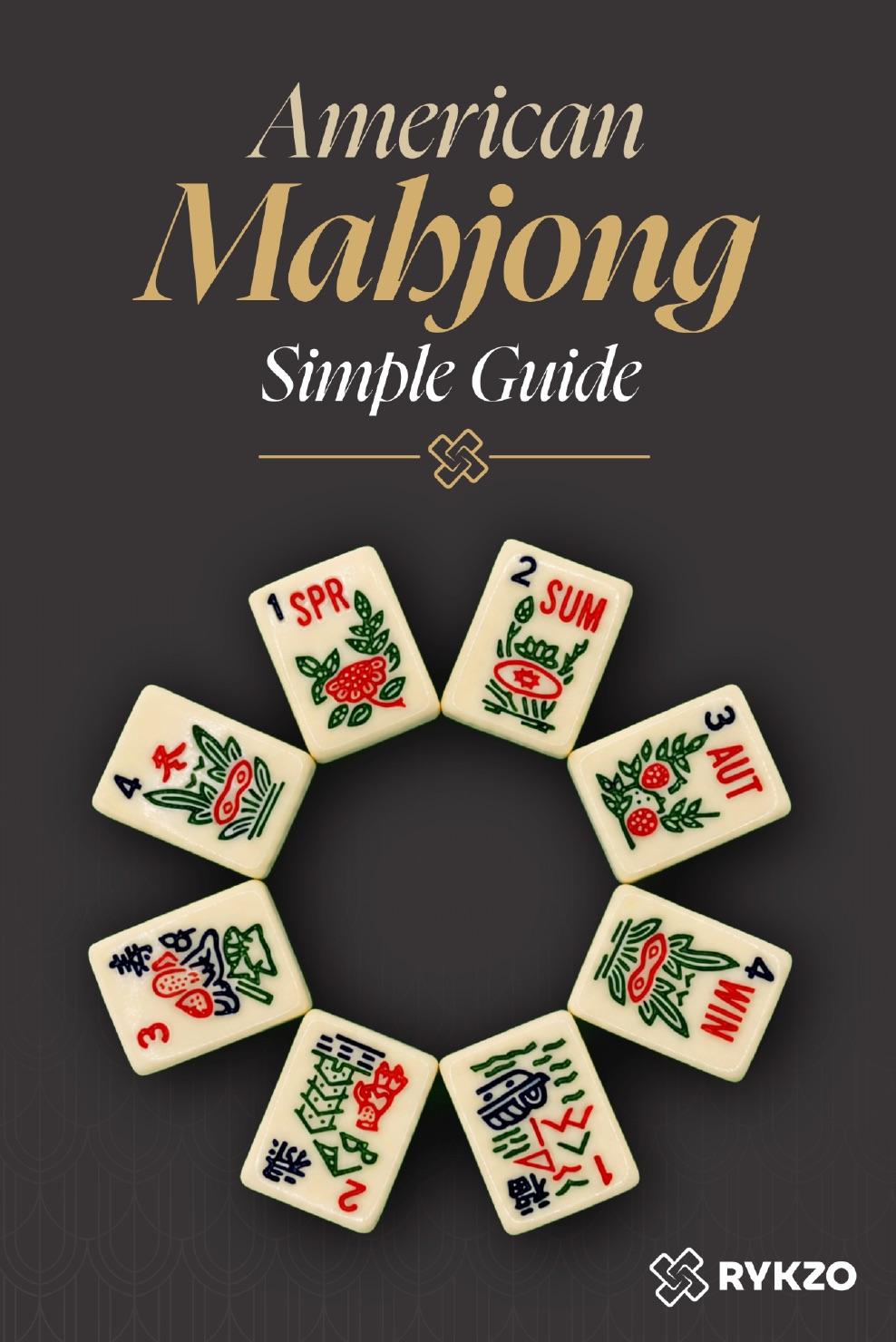
Keep the rules at your table
The Simple Guide is a free PDF of the rules in plain words. We add the league’s clarifications all year and email you each new edition.
Get the Simple GuideGlossary
- Bam
- A tile of the Bams suit, numbered 1 to 9.
- Blind pass
- On the last pass of either Charleston, passing along 1 to 3 of the tiles coming to you without looking at them.
- Call
- To say out loud that you want another player’s discard, to complete an exposure or to win.
- Card
- The list of hands that count, put out every year by the National Mah Jongg League. You win by completing exactly one of them.
- Charleston
- The passing of tiles between players before play begins. The first one is required and the second is optional.
- Concealed hand
- A hand marked C on the card. It can take a discard only for its last tile.
- Courtesy pass
- An optional pass of 0 to 3 tiles with the player across from you, after the Charleston.
- Crak
- A tile of the Craks suit, numbered 1 to 9.
- Dead hand
- A hand that can no longer become any hand on the card, as another player shows from the tiles everyone can see. That player stops drawing and discarding but still pays the winner.
- Discard
- A tile you put face up in the middle of the table, saying its name. Once you name it or it touches the table, you can’t take it back.
- Dot
- A tile of the Dots suit, numbered 1 to 9.
- Dragon
- A tile in red, green or white, with four of each. The white Dragon is called Soap.
- East
- The player who rolls the dice, starts with 14 tiles and discards first. It is also one of the four Winds.
- Exposed hand
- A hand marked X on the card. You may call discards to make exposures.
- Exposure
- A group of three or more matching tiles made by calling a discard, shown face up on top of the rack.
- Flower
- One of the 8 Flower tiles in the game, used where a hand on the card asks for Flowers.
- Joker
- One of the 8 Joker tiles in the game. It can stand for any tile in a group of three or more matching tiles, never in a pair or as a single tile.
- Jokerless
- A winning hand with no Jokers. It’s paid double, except for Singles and Pairs hands.
- Kong
- A group of four matching tiles.
- Mahjong
- What you say when you complete a hand from the card with 14 tiles. It is also the name of the game.
- NEWS
- One North, one East, one West and one South. They’re four single tiles, so a Joker can’t stand for any of them.
- Pair
- Two matching tiles. A Joker can’t be part of a pair.
- Pung
- A group of three matching tiles.
- Quint
- A group of five matching tiles. Unless it’s made of Flowers, it has at least one Joker.
- Rack
- The stand in front of each player that holds their tiles. Exposures go face up on top of it.
- Same
- What you can say when you discard the same tile as the player before you.
- Self-pick
- Winning with a tile you drew from the wall. Everyone pays you double.
- Sextet
- A group of six matching tiles. Unless it’s made of Flowers, it has at least two Jokers.
- Single
- One tile on its own, not part of a group. A Joker can’t be a single.
- Soap
- The name for the white Dragon.
- Wall
- The rows of face-down tiles that players draw from. Each player builds 19 stacks of two in front of their rack.
- Wall game
- A game that ends with no winner when the wall runs out. Nobody pays.
- Wind
- One of the North, East, West and South tiles, with four of each.
Practice what you’ve learned
Each workbook walks you through 100 situations at the table and explains each answer.
Rules Workbook Vol. 1
Who's right? 100 table rulings explained.
Rules Workbook Vol. 2
Who's right? 100 more table rulings explained.
Strategy Workbook Vol. 1
What would you do? 100 decisions explained.
Free tools
Use them at the table or print them at home, from an online tile tracker to a printable Leaderboard. They’re all free.
Online Tile Tracker
Tap or click each of the 152 tiles the first time you see it, on your phone or computer. It works with any card.
Use the trackerMahjong Tile Tracker
A free printable sheet of all 152 tiles. Cross off each tile the first time you see it. The open boxes are the tiles you haven’t seen yet.
Get the sheetAmerican Mahjong Leaderboard
A free printable table to rank your players. Update it after every session to see who’s on top.
Get the leaderboard